Published on:
November 16, 2026
Canada Is Wasting Time on North American Defence
Canadian Forces Base Esquimalt
Defence needs a timetable that survives trade disputes. Ottawa should study the B-21 Raider while securing the bases and supply chains its new aircraft will depend on.
Canada accepted its first two F-35s at Luke Air Force Base in Arizona in October 2026 for pilot training. Ottawa had committed funds for at least the first 16, yet on October 29 Defence Minister David McGuinty said the plan to buy 88 was still under review. Ottawa began that review in March 2025 amid tariff tensions with Washington. More than a year and a half later, the Royal Canadian Air Force is still planning training, squadron facilities and maintenance around an unsettled fleet plan.
On November 26, 2025, I testified in Ottawa before the House of Commons Standing Committee on Industry and Technology during its study of Canada’s defence industrial strategy. I urged Canada to develop continental defence capabilities with the United States and raised Northrop Grumman’s B-21 Raider as an option for giving Canada a long-range deterrent.
Ottawa should stop treating defence as a trade irritant. Canada can press its case on tariffs while keeping its defence work with Washington on schedule. Prime Minister Mark Carney’s Build–Partner–Buy framework gives priority to Canadian industry where it has the capacity to deliver and opens the door to more partnerships in Europe and the Indo-Pacific. The European Union’s Security Action for Europe agreement gives eligible Canadian firms and products access to EU-backed procurement.
The Arctic Over-the-Horizon Radar shows how Canada can widen its choice of suppliers and strengthen continental defence. Ottawa reached arrangements with Australia and BAE Systems Australia to acquire early warning technology for the North American Aerospace Defense Command (NORAD). National Defence plans to work with the United States to verify that the Canadian and U.S. systems can operate together.
Canada’s geography makes it a critical part of U.S. deterrence. Through NORAD, the two countries share responsibility for aerospace warning, aerospace control and maritime warning. In July 2024, Canadian and American fighters under NORAD intercepted Russian and Chinese military aircraft flying in international airspace in Alaska’s air defence identification zone.
Canada’s 2022 plan for continental defence and NORAD modernization includes investments in warning, communications and northern infrastructure. Ottawa put the 20-year cost at C$38.6 billion on an accrual basis. At the July 2026 summit in Ankara, NATO allies identified Russia as a long-term threat and committed to improving their ability to deploy and sustain forces. Delivering those northern projects on schedule is one way Canada can help meet that commitment.
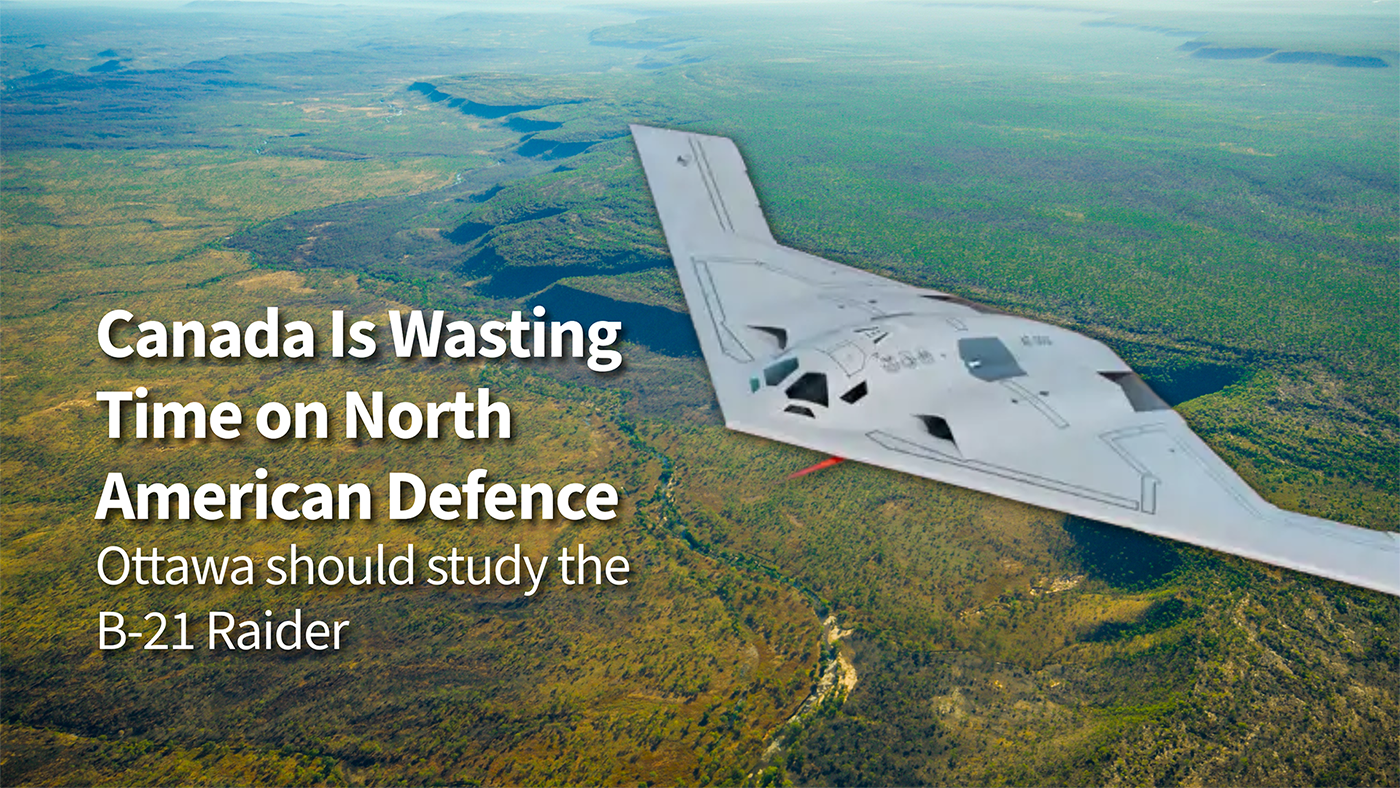
Ottawa should ask Washington to assess whether Canada could acquire and sustain 12 to 15 conventionally armed B-21 Raiders. A credible Canadian fleet could extend U.S. conventional deterrence and give Washington additional allied capacity when American forces are needed elsewhere. It would signal to potential adversaries that Canada and the United States are prepared to defend North America’s northern approaches together. That contribution could also strengthen NATO’s northern and western flanks.
Canada asserts Arctic sovereignty by maintaining a presence, monitoring its territory and waters, and acting under Canadian authority. The F-35As will strengthen air defence. Canada is acquiring 14 P-8A Poseidons for maritime patrol and anti-submarine operations, with options for two more, and 11 MQ-9B SkyGuardians for long-duration surveillance. Ottawa should retain command of any Raiders and agree with Washington on how the two governments would consult on their use.
On November 13, 2026, the U.S. Air Force confirmed the Raider’s first weapons release test. The Pentagon’s fiscal 2027 budget describes a program in concurrent development and production and a planned U.S. fleet of at least 100. A Canadian purchase would require U.S. approval to release the aircraft and its technology, as well as congressional notification and review. The study should assume a conventional configuration consistent with Canada’s commitments under the Nuclear Non-Proliferation Treaty.
A joint study should assess what the fleet would add to deterrence and estimate the full cost of acquiring and sustaining it. It should also establish how many pilots and technicians the fleet would need and whether the air force could train and retain them while bringing its other new aircraft into service. Ottawa should take those findings to Parliament before requesting funds for a purchase.
In 2025, the Auditor General found that both F-35 squadron facilities were behind schedule. The need to protect classified and sensitive information was a principal reason for building them. The MQ-9B program will also require secure ground-control stations and communications. Ottawa should set dates for getting those facilities ready and for training and clearing the people who will operate and maintain the fleets.
Ottawa has introduced cybersecurity certification for select defence contracts. It should also require traceable critical components, dependable access to software support and spare parts, and more maintenance capacity in Canada. Canadian firms already have a stake in that work. National Defence reports that more than 110 Canadian companies have been awarded over US$3.6 billion in contracts through the global F-35 program.
NATO’s investment pledge recognizes the defence value of protecting critical infrastructure and networks and strengthening allied industry.
Ottawa should finish the fighter review and give Parliament a schedule for fielding its new fleets, with dates for the work at bases and suppliers. It should also open feasibility talks on the Raider and set a deadline for reporting back. Those dates would give the air force, Canadian industry and our allies a plan they can rely on through the next trade dispute.